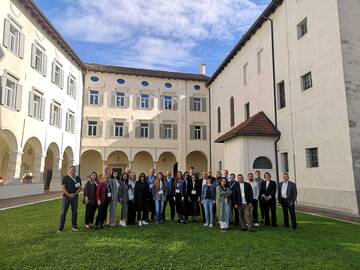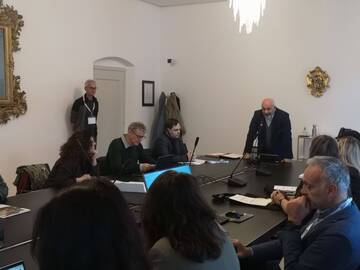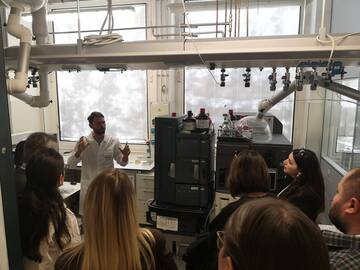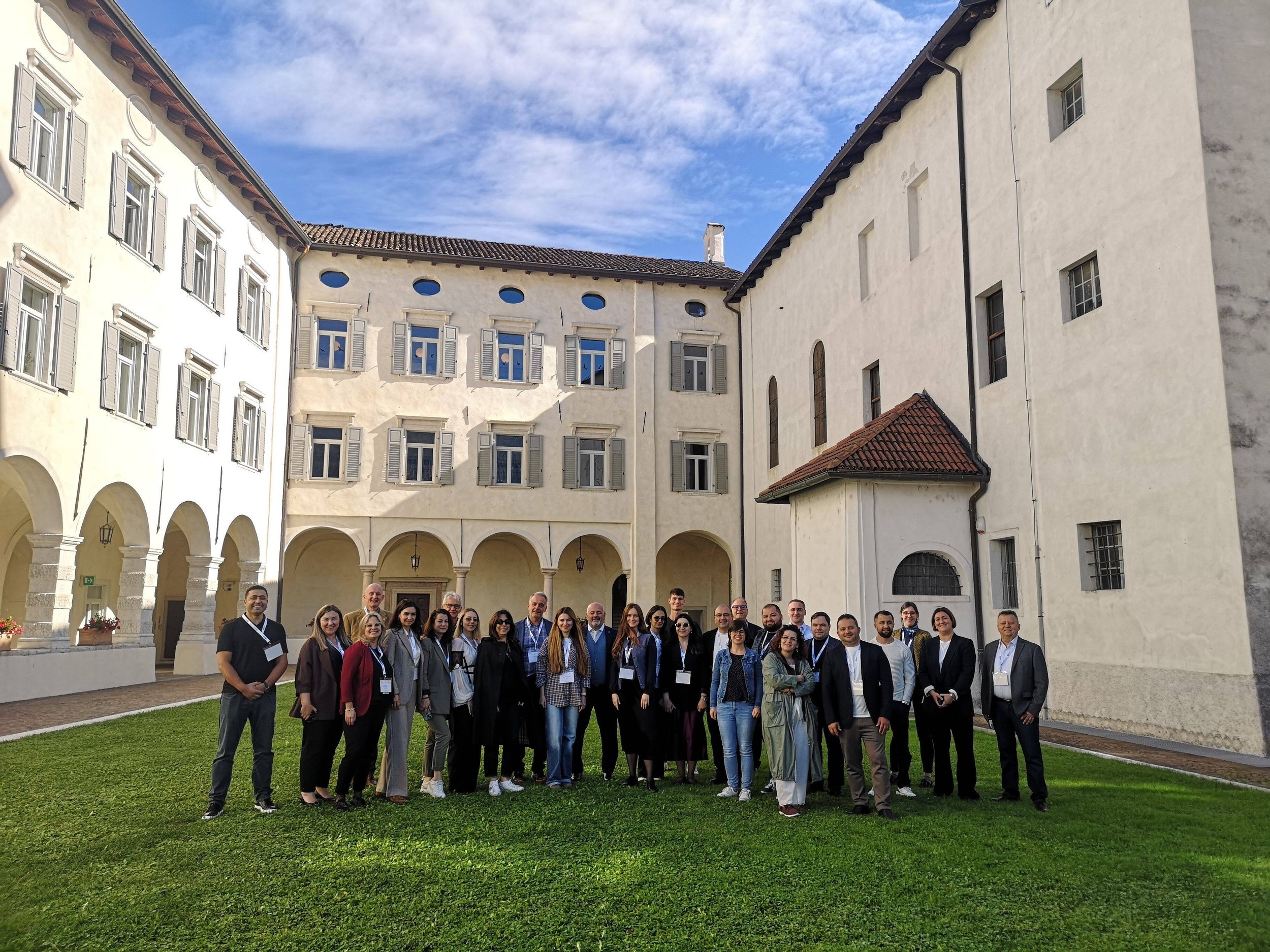
From agrometeorological data management to food traceability, three days of discussions, laboratory visits and field activities provided an opportunity to share expertise and develop new prospects for cooperation in digital agriculture. From 13 to 15 October, Fondazione Edmund Mach hosted an international delegation of 20 researchers and technical experts from Georgia, Azerbaijan, Armenia, Ukraine and Moldova as part of the CLIMB project – Capacity-building for Local Innovation, agroMeteorology, and Bio-traceability.
Coordinated by the Digital Agriculture Unit of Fondazione Edmund Mach’s Research and Innovation Centre and funded by GIZ, the German Agency for International Cooperation, the initiative primarily targets countries in the Eastern Partnership. In these countries, agricultural and agri-food systems are evolving to bridge the gap in the adoption of digital technologies, improve access to specialised advisory services and implement quality management systems aligned with European standards.
“Beyond creating opportunities for exchanges and identifying new areas for cooperation, the CLIMB project provides an example of how research and innovation can be translated into practical tools to support businesses and agri-food systems. It highlights the importance of international cooperation and knowledge transfer,” said FEM Director General Riccardo Velasco at the opening of the workshop.
The visit to Trentino represents a key milestone in the capacity-building programme planned under the CLIMB project. It provided an opportunity to gain first-hand insight into a system that connects businesses’ needs with the opportunities offered by new technologies, integrating scientific research, experimentation, training and technology transfer.
The programme focused on several strategic areas that can help promote the sustainability and competitiveness of the agri-food sector: precision agriculture, the use of agrometeorological data, analytical and isotopic techniques to support product traceability and quality, and the adoption of digital solutions in agricultural production.
During the visit, participants had the opportunity to learn about FEM’s research and technology transfer activities and exchange views with researchers and technology experts, as well as representatives of the University of Trento’s Centre for Agriculture, Food and Environment (C3A) and Fondazione Bruno Kessler (FBK). The programme also included visits to experimental vineyards and agrometeorological monitoring facilities, where participants could see first-hand how field data can support crop management and agronomic decision-making.
The delegation also explored Trentino’s research and innovation ecosystem during a visit to Manifattura – Be Factory in Rovereto. Discussions focused on technology transfer, start-ups and business support services, with contributions from HIT – Hub Innovazione Trentino and Trentino Sviluppo.